Battery Maintenance

When battery trouble strikes, guessing gets expensive. Durst battery testing equipment gives workshops, fleets, transport operators and field-service teams the tools to investigate, including carbon pile load testers, an automotive multimeter and a 1000A current clamp. Compare system voltage, battery rating, load capacity and diagnostic functions to find the right fit for the job.

Choose the Right Battery Testing Equipment

Good battery maintenance starts with knowing whether the fault is in the battery, starting circuit or charging system. Choose equipment according to the battery or system voltage, CCA or amp-hour rating, required load current and the measurements you need. Also consider whether the unit stays on a bench, travels to vehicles or moves around a busy workshop.

Compare Carbon Pile Load Testers

Carbon pile testers apply a controlled high-current load so technicians can assess battery performance under demand. The BT-2003F covers 6V and 12V batteries, provides up to 500A load current and is listed for batteries up to 1000 CCA.

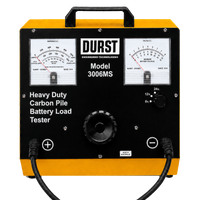
The BT-3006MS and BT-3006MT cover 6V, 12V and 24V systems, provide 1000A load current and test batteries up to 2000 CCA. Choose the steel-case BT-3006MS for a standalone format or the BT-3006MT when a trolley-mounted unit better suits workshop movement and frequent testing.

Add Circuit-Level Diagnostics

Load testers answer a different question from general electrical meters. Use the MM-78B when you need automotive functions including AC/DC voltage and current, resistance, continuity, frequency, RPM, dwell angle, duty cycle and temperature.

The MM-CA1000 is an inductive current-clamp accessory for compatible multimeters and oscilloscopes. It measures AC and DC current up to 1000A without disconnecting the cable.

Check Compatibility Before Testing

Match the selected range to the system voltage and battery rating. Confirm the battery chemistry and manufacturer’s testing procedure because the Durst load-tester pages do not state blanket chemistry compatibility.

When using the MM-CA1000, check that the receiving multimeter or scope meets its input requirements. Always follow the relevant Durst manual and never disconnect load-tester leads while the tester is loaded.

Need Charging Rather Than Testing?

The products in this collection are diagnostic tools; they do not replace a battery charger or maintainer. If the battery needs recharging or long-term storage maintenance, compare a charger specified for its voltage, capacity and chemistry.

Check each product page or contact Durst if you need help matching equipment to your workshop or fleet.

Frequently Asked Questions

Battery Testing Help & Advice

What Does a Carbon Pile Battery Tester Do?

It applies a controlled load to show how a battery performs under demand, helping technicians assess battery condition and investigate starting or charging-system faults.

Which Durst Battery Load Tester Should I Choose?

Choose the BT-2003F for 6V/12V batteries up to 1000 CCA. Choose the BT-3006MS or trolley-mounted BT-3006MT for 6V/12V/24V batteries up to 2000 CCA.

Can I Test 24V Batteries?

Yes. The BT-3006MS and BT-3006MT support 24V testing, while the BT-2003F is limited to 6V and 12V systems.

Can I Test AGM or Lithium Batteries?

Compatibility is not specified across the range. Check the battery manufacturer’s testing requirements and contact Durst if the battery chemistry or BMS requirements are unclear.

Is a Battery Tester the Same as a Charger?

No. A tester diagnoses battery performance, while a charger replenishes the battery. Select charging equipment according to the battery’s voltage, capacity and chemistry.

What Is the Difference Between the MM-78B and MM-CA1000?

The MM-78B is an automotive multimeter. The MM-CA1000 is an accessory that lets a compatible meter or oscilloscope measure AC/DC current up to 1000A without disconnecting the cable.

Can’t find your answer?

Feel free to reach out to us!

Tools for Every Task

Discover our top picks across every category.