
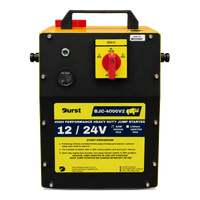
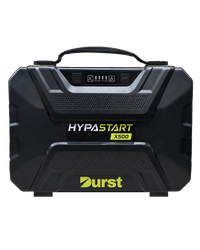

What is a 12V/24V jump starter?
A 12V/24V jump starter is a dual-voltage unit that can start both 12V vehicles, such as cars and light commercial vehicles, and 24V vehicles, such as trucks, buses and heavy machinery, from a single device. This matters for fleets that run a mix of vehicle types, since it removes the need to carry separate equipment for each voltage.
How does a supercapacitor jump starter work?
Most jump starters store energy in a lead-acid or lithium battery. A capacitance discharge starter, or CDS, works differently: it stores energy in supercapacitors instead. Supercapacitors charge and discharge much faster than a chemical battery, which is why a capacitor-based unit can go from flat to ready in minutes rather than hours.
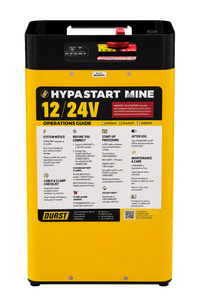
The DURST HYPASTART CDS is one example of this approach. It's a battery-less 12V/24V jump starter built around high-capacity supercapacitors rather than a battery cell.
Capacitor jump starter vs battery jump starter
The main practical differences are charge speed, cycle life and safety:
- Charge speed: a capacitor unit typically charges in minutes; a battery unit can take significantly longer.
- Cycle life: batteries degrade with repeated charge and discharge cycles. Supercapacitors handle far more cycles before performance drops off.
- Gassing risk: lead-acid and lithium batteries produce gas as part of normal charging, which carries some risk of fire or explosion in poorly ventilated spaces. A capacitor-based unit doesn't rely on this chemical process, so it doesn't carry the same risk.
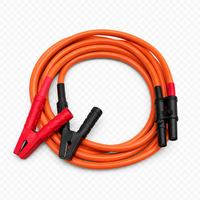
A feature specific to the HYPASTART is "HYPACHARGE", which lets the unit start a vehicle even if its own charge is low, by drawing a small amount of energy from the vehicle's own flat battery first. The process: connect the leads, switch to "ENERGIZE", wait for the "READY" light, switch to "START", then switch back to "ENERGIZE" briefly after the engine runs to top up the unit.
Is it safe to jump start a vehicle underground or in a mine?
Underground mining and other confined environments are a common setting where gassing risk becomes a real safety concern, since ventilation is limited and any accumulation of hydrogen gas from battery charging is harder to disperse. This is one of the reasons capacitor-based jump starters are used in these settings: without a battery cell producing gas, that specific risk is removed.
Custom voltage builds are also available for specific applications. Aviation use, for example, sometimes calls for a non-standard voltage such as 36V.
How long does a jump starter last?
A typical lithium-ion battery jump starter has a working life of around 2 to 4 years before capacity degrades noticeably. Supercapacitor-based units last considerably longer, up to around 20 years in the case of the HYPASTART, and are rated for more than 100,000 charge cycles. This is because supercapacitors don't undergo the same chemical wear process that battery cells do.
Can you jump start a diesel engine with a portable jump starter?
Yes, provided the unit is rated for the engine's displacement and cranking requirements. Diesel engines generally need higher cranking amperage than petrol engines of a similar size, particularly in cold conditions. The table below shows how output scales across three models sized for different vehicle classes.
Specifications by model
| Specification | HYPASTART X2500 | HYPASTART X2500MS | HYPASTART X4500MS |
|---|---|---|---|
| Voltage | 12/24 | 12/24 | 12/24 |
| Output (CCA) | 2000/1000 | 4000/2000 | 8000/4000 |
| Vehicle Class | Class 5-6 | Class 7-8 | Class 8-9+ |
| Charge Time (12-15V, 0-100%) | 25 min | 25 min | 50 min |
| Charge Time (0-12V) | 60 min | 60 min | 120 min |
| Operating Temp | -40°C to 70°C | -40°C to 70°C | -40°C to 70°C |
| Weight | 11kg | 13kg | 19kg |
Common safety and build features across the range
| Feature | What it does |
|---|---|
| HYPACHARGE | Allows use within minutes of connecting, even from a low charge state |
| Anti-spark | Reduces sparking when connecting or disconnecting leads |
| Reverse polarity protection | Prevents damage from incorrect connection |
| Anti-spike protection | Protects the unit's electronics from voltage spikes |
| 12V/24V selector | One unit covers both voltage systems |
| Self-resettable fuse | Ignition-protected fuse that resets itself after a fault |
| LCD monitor | Displays capacity and charge level |
Frequently Asked Questions
What is a 12V/24V jump starter?
A dual-voltage jump starter that can start both 12V vehicles, like cars and light commercial vehicles, and 24V vehicles, like trucks, buses and heavy machinery, from one unit.
How does a supercapacitor jump starter work?
Instead of storing energy in a battery, it stores it in supercapacitors, which charge and discharge extremely quickly and don't produce the gassing risk associated with lead-acid or lithium jump starters.
What's the difference between a capacitor jump starter and a battery jump starter?
A capacitor jump starter charges faster, tolerates more charge cycles before degrading, and carries no gassing, fire or explosion risk. A battery jump starter typically has a shorter working life and needs longer to recharge.
Can you jump start a diesel engine with a portable jump starter?
Yes, provided the unit is rated for diesel cranking loads. Diesel engines generally need more cranking amperage than petrol engines of similar size.
Is it safe to jump start a vehicle underground or in a mine?
Capacitor-based jump starters carry no gassing or explosion risk, which is why they're used in underground mining and other confined environments where battery-based units pose more risk.
How long does a jump starter last?
A typical lithium-ion battery jump starter lasts 2 to 4 years. A supercapacitor unit can last up to 20 years and withstand more than 100,000 charge cycles.
