

Your lithium battery has protection.
So why do they still catch fire?
The site is quiet and the kids are finally asleep. You're in the van at a caravan park, the shore power lead is plugged in, and the battery under the bed is charging for tomorrow. From the outside, it's just another calm night on the road.
You've done the sensible things. The battery has a BMS and the charger has its own protection, and both have looked after you for years. The last thing on your mind, as you turn the light off, is that anything could go wrong while you sleep.
If you've fitted a lithium battery to your caravan, camper, 4WD or boat, you've probably been told it's safe because it has a BMS. Most quality lithium batteries do have a battery management system built in, and most chargers have their own protection on top of that.
So here's the question worth asking. If your lithium battery is protected, why are emergency services still being called to lithium battery fires every single day?
The protection you already have
A BMS is a small circuit inside the battery that watches the cells. If something goes outside safe limits, such as overcharging, running the battery too flat or drawing too much current, it can switch the battery off to protect it. Many also keep an eye on temperature.
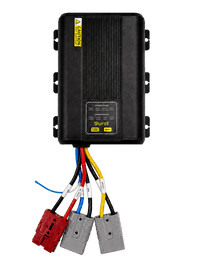
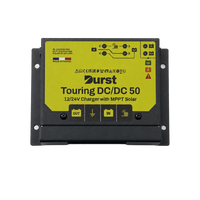
Your charger, DC-DC charger and solar controller have protection too. They're designed to charge to the right voltage for your battery type, then back off when the battery is full.
Most days, all of this works exactly as it should.
So why do lithium batteries still catch fire?
Because protection systems fail more often than people think. The numbers tell the story.
- Fire and Rescue NSW recorded 332 lithium-ion battery incidents across NSW in 2025.
- The Queensland Fire Department attended 240 lithium-ion battery fires from January to November 2025.
- That's at least 572 across NSW and Queensland in 2025. More than one a day, in just two states.
- Fire Rescue Victoria says it's responding to about one lithium battery fire a day.
Insurers are seeing it as well. Suncorp says lithium batteries' share of its biggest home fire claims, those over $500,000, doubled from 9% to 18%. QBE says it paid out more than $34 million in lithium battery claims in 12 months.
Those figures cover every kind of lithium battery, from phones and e-bikes to house batteries. But the lesson is the same for all of them: having protection isn't the same as being protected.
How protection fails, in plain words
- A cell goes bad. Age, damage or a manufacturing flaw can cause an internal fault in one cell. The BMS can only act on what it can measure, and it may not see the problem until it's well under way.
- The BMS doesn't trip. Like any electronic part, a BMS can fail. If it doesn't switch off when it should, the battery keeps working as if nothing is wrong.
- The charger keeps charging. A charger set to the wrong battery profile, or one with a fault, can keep pushing current into a battery that's already in trouble.
- A connection heats up. A loose or corroded terminal can get very hot under heavy current. That heat is at the terminal, outside the cells, where the BMS isn't looking.
- Life on the road. Corrugations, vibration, knocks and hot, closed compartments all take their toll on batteries, cables and connections over time.
None of this means your battery is about to fail. It means that when something does go wrong, the system you're relying on to catch it may be the very thing that's failed.
Why it matters more in a van, a boat or a 4WD
At home, a phone charging on the bench is in plain sight. Your house battery isn't. It lives under the bed, in a canopy, behind a seat or in a locker on the boat. It often charges overnight, from solar, shore power or the drive, while you're asleep or busy with something else.
That's the real risk. Not that lithium is dangerous, but that when a battery starts to fail, it usually happens where nobody can see it.
What you can do today
- Buy quality batteries and have them installed by a qualified installer.
- Make sure your charger, DC-DC charger and solar controller are all set to your battery type.
- Check the terminals are tight and clean, and that cables are secured so they can't rub.
- Keep the battery area clear of bags, bedding and anything that can burn, and keep vents clear.
- Charge e-bikes, scooters and power banks while you're awake and nearby, not overnight in the van.
- Take any battery that's swollen, leaking, hissing or smells odd out of service and have it checked.
Add something that's still watching
The last step is the one most people miss: something that watches the battery without relying on the battery's own protection.
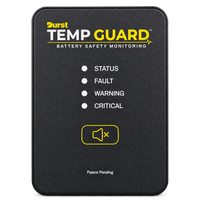
That's why we designed Temp Guard. Its sensors stick or bolt onto your battery terminals or studs and measure the temperature directly, while an ambient sensor keeps track of the air around them. It runs on its own AAA batteries, separate from your battery system. If it picks up abnormal heat, or a fast temperature rise, it sounds a loud alarm and lights up WARNING or CRITICAL on the front.
At that first alarm, you switch the charger off or isolate the battery. That may stop things going further into thermal runaway, before a bad situation turns into a fire. And it gives you time to get everyone clear.
Your BMS protects your battery. Temp Guard watches over all of it. It could save your life.
Sources
- 332 lithium-ion battery incidents in NSW in 2025: Fire and Rescue NSW figures, NSW Government media release, 7 April 2026. https://www.nsw.gov.au/ministerial-releases/nsw-leads-country-battery-reform-to-fight-fires-and-pollution
- 240 lithium-ion battery fires in Queensland, January to November 2025: Queensland Fire Department figures, Sydney Morning Herald / Brisbane Times, 25 December 2025. https://www.smh.com.au/national/queensland/it-was-just-screaming-battery-fires-more-than-double-in-three-years-20251223-p5npqo.html
- At least 572 across NSW and Queensland in 2025 is the NSW full-year figure (332) plus the Queensland January to November figure (240), from the two sources above.
- Around one lithium-ion battery fire a day in Victoria: Fire Rescue Victoria submission to Energy Safe Victoria on e-transport device safety, 13 October 2025. https://www.energysafe.vic.gov.au/sites/default/files/2026-01/FRV-Submission-Energy-Safe-Victoria-Consultation.pdf
- Lithium batteries' share of Suncorp home fire claims over $500,000 doubled from 9% to 18%: Suncorp Group FY25 results, ASX, 14 August 2025. https://announcements.asx.com.au/asxpdf/20250814/pdf/06mvhvlx49n9r3.pdf
- More than $34 million in lithium-ion battery-related property claims in 12 months: QBE Australia, 'Lithium-ion batteries: Navigating explosive risks together', 2 September 2025. https://www.qbe.com/au/brokers/risk-insight-expertise/risk-insights/lithium-ion-battery-risks
