


Picture this. It is a hot January afternoon at a caravan park somewhere inland. The van has been shut up all day, the fridge has been running off the lithium battery under the bed, and the solar has been pushing charge in since sunrise. Everyone is down at the river. Nobody is thinking about the battery. It's a made-up scene, but a familiar one for anyone who tours in summer.
Most of the time, nothing happens. Most quality lithium batteries have a battery management system (BMS), chargers have their own protection, and they quietly do their job. But summer is when batteries work hardest, in the hottest spots, while people are least likely to be nearby.
Why summer is tough on batteries
Heat comes at a battery from two directions: the air around it, and the battery's own charging and discharging. Long sunny days mean lots of solar charging, the fridge works harder, and battery compartments get hot, especially in full sun. Fire and Rescue NSW describes portable lithium-ion batteries as the fastest growing fire risk.
The Temp Guard manual notes that many lithium batteries are rated to charge only up to about 45 to 55 °C, and heat shortens the life of every battery.
Warning signs to look for
- A battery or battery box that feels much hotter than the air around it
- A battery that heats up quickly, especially while charging
- Swelling, hissing, popping, leaking or a strong smell
- A BMS or charger fault message you can't explain
If you notice any of these, switch off chargers and loads if it's safe, get everyone clear, and call emergency services on 000 if you see smoke or fire.
Keeping things cool
- Check the install. Caravan battery installs fall under AS/NZS 3001.2. The Caravan Industry Association notes the battery system needs fuse or circuit breaker protection close to the battery, and upgrades should only be done by a competent person.
- Give it air. Keep vents clear and don't pile gear around the battery. Park so the battery side is shaded when you can.
- Use the right charger settings. Match your DC-DC charger (all Durst DC-DC chargers suit smart alternators) and solar regulator to your battery chemistry.
- Watch the temperature. Batteries usually live out of sight, so add a monitor that tells you when something isn't right.
How Temp Guard helps in the heat
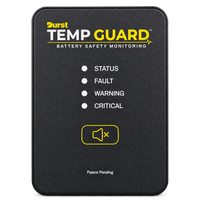
Temp Guard checks how hot the battery is, how fast it is heating and how much hotter it is than the air around it. Its WARNING point is 55 °C. In a ventilated battery area, a hot day rarely gets a battery that hot on its own, but in a closed compartment in full sun on the hottest days, heat soak alone can bring a battery to that point and set off a WARNING. That's not a false alarm. It's a useful warning sign, because a lithium battery really shouldn't sit at that temperature if it can be avoided. So if you get a WARNING on a scorcher, move the battery or its box somewhere cooler and shaded, ease off charging and loads, and once it has cooled, check for a loose terminal. Our alarm levels guide explains every level.
Temp Guard is built to work in hot places, because that's where batteries live. Its recommended operating range goes up to +55 °C, the same as its WARNING point. That's a guide for real-world use, not a point where it switches off, but like most electronics, long periods at high heat shorten its life. So where you can, mount it out of direct sun. If the battery area runs very hot, you can mount the main unit somewhere cooler and fit the remote ambient sensor by the battery.
Got more than one battery? The Temp Guard Multi-Sensor covers more of the bank, and the Remote Alarm model puts a 98 dB alarm where you'll hear it. Running a portable setup? See fitting Temp Guard to a battery box.
Temp Guard doesn't replace a good install or your BMS. It adds an independent early warning, and early warning is time to switch off, get clear and call for help.
Frequently asked questions
Does heat damage lithium batteries?
Heat adds stress to any battery and shortens its life, especially while charging. Many lithium batteries are rated to charge only up to about 45 to 55 °C.
Can a hot day set off Temp Guard?
In a ventilated area it rarely gets a battery to 55 °C on its own, but a closed compartment or battery box in full sun can, and that can set off a WARNING. It's a useful warning sign, not a false alarm: move the battery or box somewhere cooler and shaded.
Where should I mount Temp Guard in summer?
Out of direct sun where you can. Temp Guard is built for hot places, but like most electronics, long periods at high heat shorten its life. In a very hot battery area, you can mount the main unit somewhere cooler and fit the remote ambient sensor by the battery.
What should I do if my caravan battery gets hot?
Switch off chargers and loads if it's safe, get everyone clear, and call emergency services on 000 if you see smoke or fire.
Do I still need a BMS if I have Temp Guard?
Yes. Temp Guard works alongside your BMS and charger protection as an independent early warning.
More on Temp Guard
- How Temp Guard works and who it's for
- Temp Guard alarm levels explained: WARNING, CRITICAL and RAPID EVENT
- What to do if your battery alarm goes off
- Still watching when protection fails: why an independent battery monitor matters
- Fitting your own lithium battery in a battery box? Add Temp Guard
- Protect your family this Christmas holidays: a caravan battery safety checklist
- Lithium battery protection: why batteries still catch fire (already live)
Meet Temp Guard. See the Temp Guard range.
Designed by Durst Industries Australia. When protection fails, Temp Guard is still watching.
Last updated 4 November 2026
